Standardise the firm before you scale it
At five to twenty-five people the problem is no longer the work — it is the handovers. Managers, seniors and article trainees each run things their own way, partners cannot see who is overloaded, and good work goes unbilled. ERPCA gives the firm one way of working, with the numbers to manage it.

Sounds familiar?
- The same service is done three different ways by three different seniors.
- Partners find out who was overloaded after the deadline, not before.
- Article trainees' time is invisible, so it is neither managed nor billed.
- Attendance, leave and stipends eat partner hours every month.
On the growth journey
Firms like this are usually at the 👥 Capacity stage — from control to capacity. Read the playbook.
How ERPCA fixes it
Workflows and checklists, firm-wide
Define GST, TDS, audit and ROC once as workflows with checklists. Every job follows the same steps whoever picks it up, and review becomes a checklist, not a re-do.
Workflow management →Capacity you can see
Daysheets and timesheets show who is busy, who is free and what each job really costs — so work is allocated by capacity, not by who is nearest.
Time tracking & WIP →People operations off the partners' desks
Selfie and geofenced attendance, leave, and payroll with PF, ESI and TDS — run by the system, approved by you.
Team management →Bill every hour, recover the WIP
Hours flow from timesheets into invoices; unbilled work and 30/60/90-day debtors are reviewed weekly, not at year-end.
Billing & receipts →What this looks like on a normal Tuesday
One screen the partner opens in the morning: what is due, who is on it, what is stuck, and what has been billed. The same data the team works in all day — no separate report to prepare.
See it with your own clients →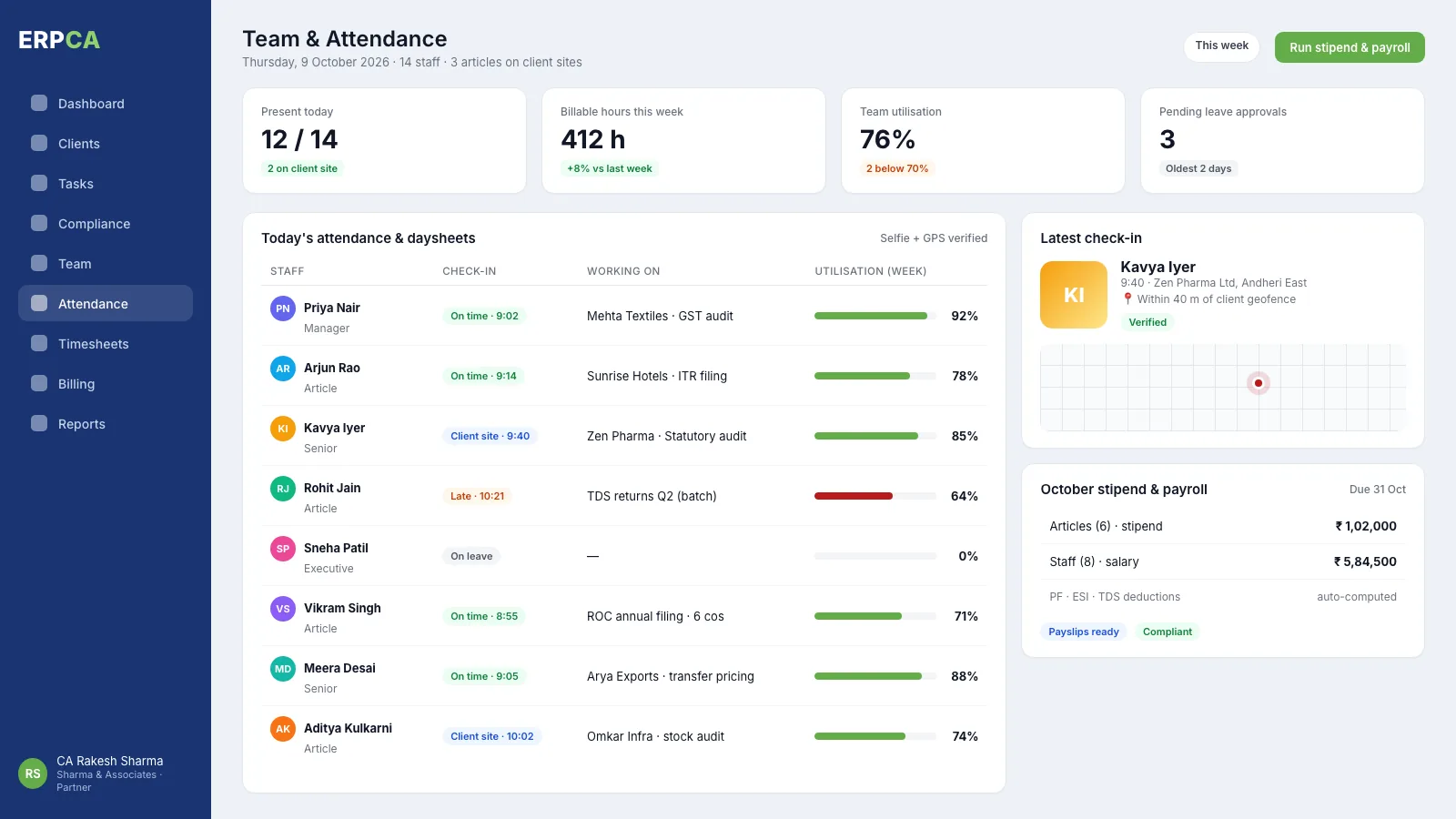
What you would use on ERPCA
Everything above is part of one platform — switch on what you need, add the rest as the firm grows. See plans.

Proof
10–15%
of paid hours most firms find recoverable once daysheets are in use
Transforming CA Jatin Sethi's practice
Read how a practice like yours made the change, what it chose to switch on first, and what it got back.
Questions firms like yours ask
Our seniors resist new systems. How do firms get adoption?
By making the system the only place work exists: tasks are assigned in ERPCA, documents arrive in ERPCA, and the daysheet is how the day is closed. Our onboarding team trains managers and staff separately, and most firms are fully on by the second week.
Can we keep our own checklists and formats?
Yes. Workflows and checklists are yours to define; ERPCA ships with standard ones for GST, TDS, audit, ITR and ROC that firms edit rather than build from scratch.
How quickly do we see the capacity picture?
As soon as daysheets are in use — usually within the first fortnight — partners see utilisation per person and cost per job on the dashboard.
More by firm size
See it on your own firm's numbers
Thirty minutes, on a call, with your clients and workflows rather than a demo account. Live in about three days if you go ahead.