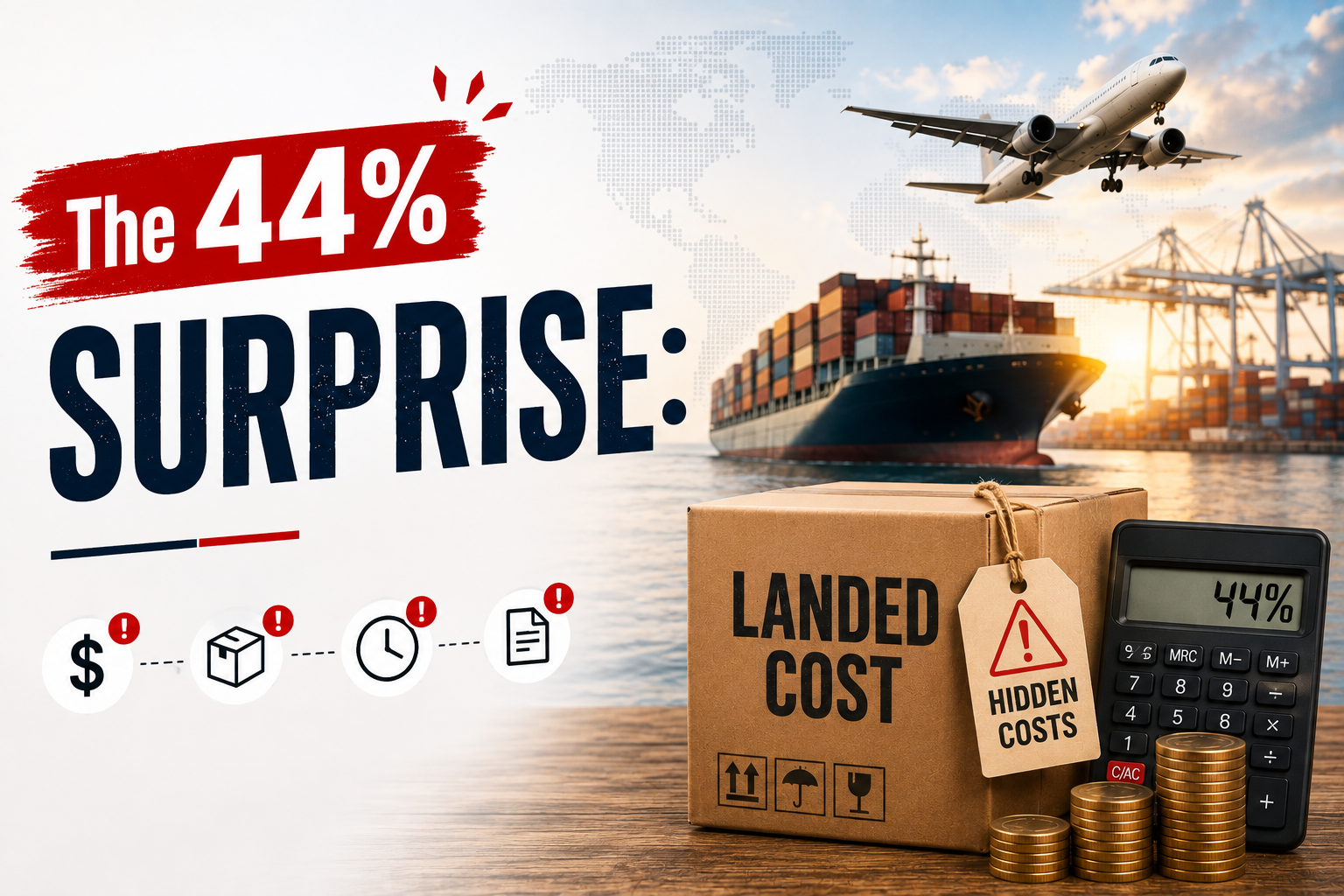
The first time we imported stock from the US, I priced it the way most new sellers do: US price, times the exchange rate, add GST, add margin. Simple.
We lost money on every order for six weeks before I sat down and did the math properly.
I run CrowCrowCrow, an import e-commerce platform — we’ve been bringing goods into India since 2013. In that time I’ve watched dozens of smaller import sellers make the exact mistake I made, and I’ve noticed something: by the time they discover it, they’re usually sitting across from their CA, confused about why the bank balance doesn’t match the sales report. Which means some version of this problem is probably in your inbox right now.
So here is the landed-cost math the way an operator actually experiences it — and the specific places where a CA can save an import client real money.
Sellers think of import duty as a single percentage. It isn’t. Three layers apply, in a fixed order, and the order matters because they compound:
Charged on the assessable value — essentially the CIF value (cost + insurance + freight) converted at the customs-notified exchange rate, not the Google rate. The BCD rate depends on the HSN code: roughly 10% on stationery, 20% on most cosmetics and watches, higher on a few protected categories.
10% — but 10% of the BCD, not of the product value. Small number, always forgotten.
Here’s the part that stings: IGST is not charged on the product price. It’s charged on assessable value + BCD + SWS. Tax on tax, fully legal, and it’s where every back-of-napkin calculation falls apart.
Watch what that does to a real product. Say a client imports a skincare serum: US price $20, freight and insurance $8, so CIF $28. The interbank rate today is around ₹95 — but nobody imports at the interbank rate. Customs’ notified rate sits a rupee or two higher, and the card rate after bank markup lands higher still. So let’s use ₹97, which is closer to what the money actually costs: about ₹2,716.
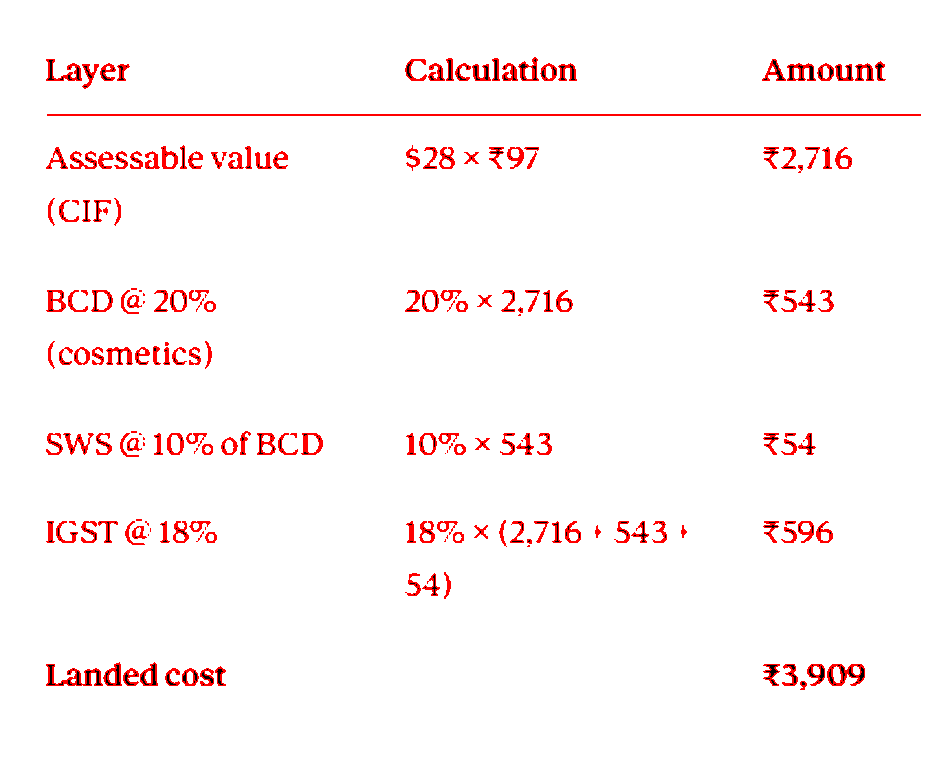
Total government take: ₹1,193 — roughly 44% on top of CIF, against the “18% GST” the client had in mind. And we haven’t yet added last-mile courier, payment gateway fees, or a returns reserve. A seller pricing at “US price × 97 + 18%” — ₹3,205 in this example — is selling below cost on every unit and won’t see it until quarter-end.
The rule of thumb I give people: for a typical consumer product, a US sticker price needs a multiplier of about 1.6–1.8× in INR before the seller earns a rupee. If your client’s catalogue is priced below that band, the P&L is already bleeding; the reports just haven’t caught up.

The GST rationalisation effective 22 September 2025 collapsed the 12% and 28% slabs into a structure of 5%, 18%, and 40% for sin and luxury goods. IGST on imports follows the same schedule.
This cuts both ways. Clients whose products moved down from 28% are quietly overcharging if their MRPs still carry the old tax assumption. Clients whose 12% items moved to 18% are undercharging. Either way, any import catalogue priced before September 2025 and not re-mapped HSN-by-HSN is wrong today. That re-mapping exercise is an hour of work per hundred SKUs, and it is exactly the kind of thing a client never does until their CA tells them to.
Here is the most expensive mistake in import e-commerce, and it isn’t in the duty stack at all.
That ₹541 of IGST in the table? For a GST-registered business it’s not a cost — it’s input tax credit, claimable in full. But only if the paperwork is right. The credit rides on the Bill of Entry, and the Bill of Entry must carry the importer’s GSTIN so the transaction flows from ICEGATE into GSTR-2B. No GSTIN on the BoE, no reflection in 2B, no credit.
In practice, the leak happens in mundane ways: the courier or freight forwarder clears the consignment in the proprietor’s personal name; the client’s “supplier handles shipping” and nobody ever sees a Bill of Entry; goods come through a consolidator with someone else’s IEC on the paperwork. The seller pays 18% like a final consumer while running a business. On ₹50 lakh of annual imports, that’s ₹9 lakh of working capital donated to the exchequer for want of one field on a form.
One more thing worth telling clients bluntly: there is no meaningful duty-free route for commercial imports. The old trick of marking parcels as “gifts” was shut down back in 2019. Anything imported to sell will be assessed — plan for it or be surprised by it.
The duty stack at least shows up on a Bill of Entry. There’s a second set of costs that never appears on any document your client will bring to you — and for small importers it’s often the difference between profit and loss.
Start with the card. Most Indian cards charge a foreign-currency markup of 2–3.5%, and then 18% GST applies on that markup fee — call it up to 4% of every dollar spent, gone before the goods move an inch. If the US checkout helpfully offers to charge “in INR” — dynamic currency conversion — that’s another 3–5% buried in the conversion rate. On our ₹2,716 example consignment, the money side alone can quietly add ₹100–200 per unit. Clients never book this anywhere; it just evaporates inside “purchases.”
Then the TCS line. Genuine business imports paid through banking channels against a Bill of Entry are trade payments — no TCS. But the moment a proprietor pays foreign sites through personal cards and personal accounts, those spends drift into personal-remittance territory: cross ₹10 lakh aggregate in a year and 20% TCS can apply on remittances — money you eventually get back at return filing, which means it sits with the department as dead working capital for months. And the government has been circling international card spends since 2023; the current deferral is one Budget away from ending. A client mixing personal payment channels with business imports is stacking risk on both the tax side and, as covered above, the ITC side.
Then the part nobody prices at all: the card itself. To buy from US sites, your client’s card number is saved on half a dozen foreign checkouts. International online transactions don’t carry the OTP second factor Indian buyers assume protects them — stolen card details work instantly. Disputes run on card-network chargeback timelines against a merchant with no Indian presence; the RBI ombudsman can lean on your client’s bank, not on a warehouse in Kansas. Add auto-renewing “subscribe & save” traps that re-bill in dollars, and the sensible advice is blunt: virtual cards with hard limits for foreign checkouts, and the firm’s primary card never touches one.
If you have import e-commerce clients, these six questions surface 90% of the problems:
- Is there a Bill of Entry for every consignment, and is the firm’s GSTIN on it? If the client can’t produce BoEs, start there. That’s where the missing ITC lives.
- Does BoE IGST reconcile with GSTR-2B before it’s claimed? Courier-cleared imports sometimes reflect late; claiming ahead of 2B invites notices.
- Does the landed-cost sheet compute BCD by HSN, then SWS, then IGST on the stacked base — or does it use one flat percentage? Flat percentages are how the 44% surprise happens.
- Has the catalogue been re-priced against the post-September-2025 rate schedule?
- Is the true forex cost in the sheet? Card markups plus GST on the fee run 2–4% above the mid-market rate. On thin import margins that’s often the entire profit.
- How is stock actually being paid for? Personal card on a foreign site means forex markup, possible TCS exposure past ₹10 lakh, broken ITC paperwork, and the firm’s card number sitting on foreign servers. One question, four problems.
At CrowCrowCrow we eventually rebuilt everything around one principle: the price a buyer sees is the landed price — duty, SWS and IGST already inside, paid in INR on an Indian gateway so nobody’s card ever touches a foreign checkout, with a GST invoice on every order. Half our support tickets used to be some version of “why is there an extra charge?”, so we also published a plain-English customs and import duties guide explaining how these layers work; it answers the question better than a support agent doing math in a chat window at 11 pm.
That decision came out of a conversation with our own CA, incidentally. The duty stack wasn’t the hard part — the hard part was admitting our pricing model had been wrong for months and nobody inside the business had caught it. That’s the real value a practice adds here. Import e-commerce isn’t a business with a tax problem attached; it’s a tax structure with a storefront on top. The sellers who understand that — usually because their CA made them — are the ones still standing after year two.